And the Winner is:
Jess Elliott!
Contact me at authorkitmorgan@gmail.com Jess!
 Kit Morgan
 Don’t you just love Western historical romance? We love the heroes and heroines and how they dressed. We also love reading tidbits about how they lived, their customs of the day, social events, and the simplicity of the time. But there’s one thing most historical authors only touch upon in their novels. Probably because if they went into great detail, it would take up far more words than they want and slow down their story. I’m talking about laundry.
Back in the day doing the laundry wasn’t a matter of tossing your clothes into a washing machine, putting in some detergent, closing the lid, and pushing a button. It was a much more arduous task, one that could take 2 to 3 days depending on the size of one’s family.
We’ve come a long way since the twin tub and the drum washing machine. But before them, of course, was the simple washtub. Before hot and cold running water you had to haul water from a nearby well, creek, or river. To get the job done in a timely manner, you had to enlist the help of everyone in the family to fetch and carry bucket after bucket, because you needed water for both washing and rinsing. Then you had to heat the wash water in an iron kettle or a large metal washtub. This took time and somebody had to tend the fire. While that was going on someone else sorted the clothes into whites, colors, and that special pile of the extremely dirty. You washed the clothes in that order. White’s first of course. Who wants to wash their whites in disgusting dirty laundry water?
Once put into the hot water, someone had to stir the clothes with a long stick then remove and scrub them on a
washboard with homemade soap. This could take up quite a bit of time in and of itself. For those unlucky enough not to have a washboard, a good-sized rock was the answer.
 Washboards were placed vertically in the washtub after the clothes were removed from the tub and set aside. Then one at a time, each piece of clothing was rubbed briskly on the metal ridges and plunged back into the water regularly. When the water became too dirty they had to heat another batch. Then they rinsed their clothes in cold water to remove the soap, rung the clothes out by hand or used a ringer if they had one. If not, they slapped each piece of clothing against a trusty rock. Then they hung them up to dry. For large families, is it any wonder this took so long? Aren’t you glad for your Maytag?
Though many of us enjoy our washers and dryers, there are also a lot of folks who like to line dry their clothes and bedding. I’m one of them. I love to dry clothes on the line in the summer and get that fresh air scent. What other conveniences are you happy we have now? Has anyone ever cooked on a cookstove? Have you ever used a tub washer? Did you grow up with one?
I’ll pick a random person from the comments below to receive a copy of my upcoming e-book, dear Mr. Tindle, which will be out on May 31.

Stephanie Jenkins Ortiz Cerrillo!
You’re my Winner!
Contact me at authorkitmorgan@gmail.com so I can get your e-book to you!
 I could not “think out” a dinner my husband could eat without a cookery book, nor could I apportion out the righteous need of rations to each individual member of my household without having some indisputable precedent to go by, and this latter I found in Mrs. Beeton’s admirable ‘Book of Household Management.’ Or so says Mrs. Pender Cudlip, writing in the 1880s magazine, The Modern Housewife.
In other words, if she didn’t have a cookbook she was up a creek when it came to meal planning.
Hi! Kit Morgan here. As folks are doing a lot more cooking nowadays, I thought it would be fun to take a look back and see how things were done in the late 1800s.
If you happen to be a woman married to a man of means and could afford a cook, your culinary knowledge gained by reading and observing other people’s dinner tables came in handy when you had to discuss with your cook the meals of the day. This ceremony was done usually fifteen minutes after breakfast in either your morning room or library or whichever room you happen to be and summoned the cook to you. If your cook happened to be less experienced or new, this was your chance to comment on the previous day’s meals, give your advice on upcoming meals and otherwise impress your new employee with your culinary prowess. Even you couldn’t boil water. A lot of women read cookbooks back then. We’re not talking women the likes of Downton Abbey. Lady Grantham was married to an earl, remember. Our lady of means might be married to a prominent businessman or banker. At any rate, she aimed to know her stuff and one of those things was cooking, even though she wasn’t the one doing it.
In fact, many mistresses of their domains who couldn’t boil an egg to save their life, were very good at teaching their 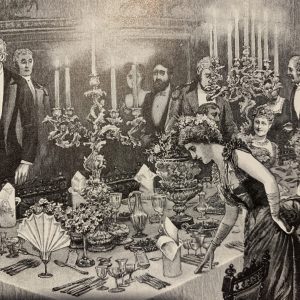 cooks what to do. They knew the correct food to have, the sauces that went with them, and how everything should taste. It wasn’t until after WW1 and the subsequent shortage of servants that they had to put their money where their mouths were and actually start cooking themselves. If they were really lucky, their daughters would have had a few cooking lessons at school.
In houses of far lesser means where there was no meeting with a cook, (namely, because there wasn’t one) the mistress of her humble abode went to the kitchen after breakfast in the dining room and got to work. She had to look in the larder and check what cold meat and pastry was uneaten, and, based on her meal planning, order what was needed to complete her meals for the next few days. She just had to make sure she got her foodstuffs back to the house in time to receive morning visitors. She might not have a cook but by golly, she had the manners of the day and adhered to them. She might even have a maid!
 In smaller houses that did have a cook, the mistress came down to the kitchen to see her. The cook, therefore, had to make sure that the kitchen was spotless, with a white cloth placed at the end of the table and a slate or a menu book and pencil placed on the cloth. if you were a kitchenmaid, you were banished from the kitchen during these meetings.
A cook’s morning work int he kitchen consisted of making pastries, jellies, creams, or the more fancy dishes. After dishing up the dining room luncheon, she had the afternoon to herself. That is if there was no large dinner party to prepare for. Her busiest time was about five minutes to nine in the evening when she was dishing up dinner. This was always a tense atmosphere, trying to get everything just so, and it was worse if there were guests. Everything had to be organized and act as a finely oiled machine. Heaven forbid she burn something!
And to think we’re ecstatic when we get to order a pizza!
Have you done a lot of cooking over the last month? Not much has changed for me and my routine, but I know for quite a few, they are cooking more than ever. I’ll pick a random comment to receive a free e-copy of Dear Mr. White, one of the finest cooks in my story world!

You can email me at authorkitmorgan@gmail.com and give me your mailing address!
 Hi, Kit Morgan here and today I want to talk about how the folks in the old west and the Victorian era passed the time with games, magic tricks, and stories. Many of which you could order from a catalog.
Nineteenth-century catalogs carried a variety of goods including games and sporting goods. You could outfit an entire baseball team from a catalog back in the day as well as get your hands on all sorts of toys, games, puzzles, books and other sources of entertainment, including plays! And right now, a lot of us are looking for fun little diversions to keep our eyes off the current global situation for a moment or two.
One thing I’ve noticed on social media this last week is the resurgence of board games, card games, even marbles! But for people in the nineteenth century, this was normal fun stuff they relished and enjoyed.
There were even prequels to some familiar games we have today. There was the Nineteenth-century version of the Game of Life. Only back then it was called Game of Life’s Mishaps. And naturally, they had The Monopolist, from which a description reads: On this board, the great struggle between Capital and Labor can be fought out to the satisfaction of all parties, and, if the players are successful, they can break the Monopolist, and become Monopolists themselves. I wonder if it took as long to play as our modern game of Monopoly does!


They also had moral games such as The Pilgrim’s Progress. Like the aforementioned games, these were often sold three games in one game board. Game of Life’s Mishaps also included a game called Domine Rex and Diamonds and Hearts. The Monopolist also included a game called Ten-Up and Mariner’s Compass. Pilgrim’s Promise came with Going to Sunday School and Tower of Babel.


There were all sorts of magic tricks and the paraphenalia needed to perform them. And, there were board games from back then that I’ve never seen or heard of. Maybe you have. Quoits, Tight Rope Dancing, Croquet, Naval Engagement (a predecessor to Battleship, perhaps?) Bear Hunt, Rabbit Hunt, Fishing, The Pearl Divers, Falconry, Spider and Fly, LeapFrog, and Duck Shooting. Two games were advertised to come with all of these individual games, Morrice and Archery, creating three games for the price of one. The price? .75 cents.
What board games do you remember? Are there any that you can’t find anymore? Which ones do you still like to play? How about we play the game of I’m giving away a signed copy of Dear Mr. Weaver to a random winner from the comments? Ha ha! But yeah, that is my giveaway!

 If only we knew then what we know now. Yes, I’m talking about the medical profession. Doctors in the old West weren’t all they were cracked up to be. Many had no formal education at all. And the ones that did often practiced medicine in the bigger cities.
But thankfully, there were those that went west. And just as unfortunate, so did a good share of quacks, home bugs, charlatans, swindlers, and tricksters. each of these unscrupulous chaps (not to mention a few women) hawked tonics, potions, and pills aplenty. And, believe it or not, they were quite successful at it too. So long as they were plying their wares to an unsuspecting public.
So how did they do it? Unsuspecting or no, one would think the people would figure it out. Easy. They played on people’s fear of death and sickness. Problem was, all those tonics potions and pills didn’t work. Half the time they did more damage than good and even killed the poor patient. Granted, there are those that have scams in the ensuing decades since the old West existed and thankfully we’re not as unsuspecting as we used to be. But back in the good old days, things were done differently and often painfully. For instance, have a baby that won’t stop crying? Why not reach for Mrs. Winslow’s Soothing Syrup? If that wasn’t handy you could try Godfrey’s Cordial, Jayne’s Carminative Balsam, or Daffy’s Elixir. Hmm, I wonder how daffy, Daffy’s Elixir made you? Considering all of this contained morphine or opium (no wonder babies went right to sleep) it was a safe bet one might get a little loopy. Problem was, some people took them and never woke up.
But opium did get an upgrade. And when it did, it got a new name too. Laudanum. For those of us who write historicals, this is  something we’ve used in our stories on occasion, having our characters down in a spoonful or two mixed with water. believe me, if there was anything else we could give our characters to get the better we would. But there’s only so many things available in the time. You were writing in.
Opium might’ve started wars in the East, but its upgraded version, laudanum, took its toll on the west. Sure, it wasn’t as potent as straight opium, but laudanum packed its own particular punch and tasted better. Added alcohol only intensified the euphoric and mind-altering effects. Laudanum was touted by most physicians of the time and you could get it without a prescription. You could take it home, (no opium den required) and, if you were really good at taking it as the doctor ordered, form an addiction. This dark side of early medicine was all too real. Druggists of the times sold gallons of laudanum, opium elixirs, and narcotic nostrums. And then morphine showed up …
 Back in the 19th century, bleeding, purging, leaching, and enemas were still the rage. Yes, I know, ew! But when morphine came along, doctors discovered a much gentler treatment. Coupled with opium, it went on to occupy materia medica tests forever after and was recommended for obvious ailments like pain and diarrhea. By the way, Cholera and dysentery killed far fewer people, thanks to opium, so there is that. However, the medicines were also thrown at people for anything that ailed them. And I do mean anything. They used it for rabies, tetanus, ulcers, snakebites, diabetes, poisoning, depression, and other mental illnesses. All of which was said to be cured by these incredible wonderment’s. Are you shaking in your boots yet? Yikes!! Looking for a drug rehab near you is what you must do when it comes to addiction issues.
Since I researched these things, (I’ve had characters with bad coughs and other ailments) I’ve grown a new appreciation for modern medicine and sometimes think about the quacks of the 1800s when I’m in line at the pharmacy. We’ve come a long way since then, thank Heaven. And though there were a lot of tricksters back in the day there were also some good home remedies that actually worked. Did your grandparents or parents use home remedies? If so, what were they? I’ll pick a random winner from the comments below to receive my Brides of Noelle Book Collection, which does include the story with the character with the bad cough. Oh horrors, he had to take some laudanum! He survived, by the way …
 Many of us who write historical western romance have the occasional scene that takes place in a mercantile or general store. I myself often have a character buy some candy for either themselves or children. But what was that candy like? I mention licorice whips and peppermint sticks in my stories, but what else did they have back in the day? Well, here’s a little history of some of the things we’ve come to love.
Sometime in 1847, a gentleman by the name of Oliver Chase invented the machine for cutting lozenges and the famous Necco Wafer was born. The first branded chewing gum came along (made from tree sap) the following year. Down the road in 1854 Whitman’s chocolates joined the candy crowd. How many of you still buy them today? I occasionally get the itty bitty box at my local drug store. And for those of you into chocolate-covered liquid centered cherries, (yum!) they were invented in 1864 by Cella’s Cherries. Of course, we can’t forget about Richard and George Cadbury. Where would the Cadbury bunny be without them? But before Cadbury bunnies, they were best known for making the first box of Valentine’s chocolates back in 1868. Go, team Cadbury!
 Fast forward to 1879 when William H. Thompson comes up with Thompson Chocolate. Okay, so another chocolatier. But he also stated his goal “to make only quality products” and set a new standard.
Then along came candy corn in 1880. Invented by the Wunderle Candy Company, it’s still a best-selling Halloween candy, and will probably still be around for years to come!
Other candy companies began to crop up. Reed’s Candy came along and set up business in Chicago. They invented a yummy butterscotch candy that became known as Reed’s Rolls. Then in 1890, The Piedmont Candy Company was started in Lexington Kentucky. Their claim to fame was Red Bird Peppermint Puffs. Following this came  Claus Doscher in 1891. He ventured to France, tried the taffy, then came back to America and offers up French Chews.
And the confection list continues! Quaker City Confectionery Company brought us Good & Plenty candy in 1893. They are the oldest branded retro candy still being sold today. Wow! And of course, we can’t forget Mr. Milton Hershey. He moseyed over to the World’s Columbian Exposition, watched chocolate being made, and thought, hey, I can do that! It wasn’t until 1894 that he came up with the first American candy bar. What he’s best known for, however, wasn’t invented until 1895. The Hershey Milk Chocolate Bar.
Wrigley’s Juicy Fruit and Spearmint chewing gum also came out of the 1890s along with Thomas Richardson’s pastel mints and Leo Hirsch Field’s Tootsie Rolls.
What’s your favorite old-time candy? Is there one you haven’t seen for a long while and wish they’d bring it back?

Welcome to Day Three of Jingle, Jangle, Spurs! Before I wrote my first western romance, I wrote science fiction/fantasy time travel and still do under another pen name. What most folks don’t know, however, is that I also wrote a teleplay. And guess what, it was a western!
 I had my first western book idea years back and started the book for fun, when lo and behold, I got approached by a very small production company that had joined with a western re-enactment group. These guys wanted a fun story they could shoot a tech reel for, (tech reels are to see what it might look like and how something flows on film) before they got serious about trying their hand at turning it into a major project. So I went to work and the tech reel was shot between Thanksgiving and Christmas. What an education that was! Not to mention a lot of fun. It was shot in Northern California and we all had a blast. I’ve never had a holiday season quite like it. It was definitely a combination of Jingles, Jangles, and Spurs. Lots of spurs, as the re-enactors acting as the bulk of the characters, were in full costume. The pictures are some I took while on the set. Yes, I got to be there!


These guys took their westerns seriously and I found out how much when they took me along to some western events in Los Angeles a few times. Some were friends with old-time actor favorites such as cast members from Little House on the Prairie, Gun Smoke (I got to meet Amanda Blake who played Miss Kitty) and Doctor Quinn Medicine Woman. One gentleman knew a few stuntmen (Steve McQueen’s for one) and I got to meet and hang out with Jack Elam and also James Best (Dukes of Hazard). Those were such fun times but also a lot of work. They didn’t pursue the project due to various circumstances, so I still have my rights to that story. One of these days I’ll get around to finishing the book for fun. But I wouldn’t trade those weeks for anything. I met a lot of great folks back then and had the best holiday season ever. And, got to hang out with folks who were western enthusiasts through and through, both professional actors and re-enactors alike.


I have to say, my biggest thrill was meeting the wonderful Jack Elam, who shook my hand and thanked me for being a writer. “Without you, we’re nothing,” he said. “it’s an honor to meet you!” As a kid, I grew up watching this actor in Disney movies and various westerns. And yes, he DID look like that! And he also had a wonderful smile. I have pictures I took of him but I’m at my son’s for Christmas and don’t have access to them here. I had to post one of good ol’ Jack though, for those that don’t recognize the name but definitely will the face.
Merry Christmas, everyone! I hope you all have a wonderful holiday and get to read a lot of Christmas stories that take place in the old west! Speaking of which, what old-time actors from your favorite western shows or movies would you like to meet and spend time with around the holidays?

