Paty Jager Looks at Nimiipuu Clothing

My historical paranormal, Spirit of the Mountain is set among the Nez Perce (Or Nimiipuu as they call themselves) in the time before the White man encroaches on their land. To write this story I had to do a great deal of research into the way of life of this group of people. The more I studied them the more interested and excited I became to write a story about their life style.

In the 18th century when my first book takes place the Nimiipuu were dependent upon nature for their clothing. Garments were made from dressed hides and furs from mountain sheep, deer, elk, antelope, mountain goat, bison, wolf, bear, coyote, and smaller creatures. The clothing worn by the men were breech-cloths, double aprons, leggings poncho shirts, belts, robes, blankets, moccasins, mittens, neckpieces, and fur or animal head caps. The women wore belted dresses, long shirts, skirts, aprons, leggings, poncho shirts, blankets, knee-length moccasins, and mittens.  The women also wore fez-shaped hats. These were made of twined grasses and hemp cordage in warm weather. Both sexes adorned their hair with fur strips in their braids. Boys and girls dressed much like their parents, and the younger children ran around in the warm weather with very little clothing.

Their daily clothing unless they were a headman, shaman, or warrior usually had little adornment. However for ceremonies they wore ornamented clothes decorated with polished elk’s teeth, beads, discs of stone, bone or shell, dyed or natural-colored porcupine quills, feathers, beaver teeth, paint and any other material they could find that could be sewn on and make their clothing eye-catching.

I’m a historical writer first and foremost so I had to have this information before I felt comfortable writing this story. I tried to incorporate as much of the Nimiipuu way of life into the story as I could and keep the pacing moving forward.  But the whole spirit faction of the story is made up.  That is fictional and I hope I did justice to the spirit and the world of the Nimiipuu.

Blurb for Spirit of the Mountain
Wren, the daughter of a Nimiipuu chief, has been fated to save her people ever since her vision quest. When a warrior from the enemy Blackleg tribe asks for her hand in marriage to bring peace between the tribes, her world is torn apart.

Himiin is the spirit of the mountain, custodian to all creatures including the Nimiipuu. As a white wolf he listens to Wren’s secret fears and loses his heart to the mortal maiden. Respecting her people’s beliefs, he cannot prevent her leaving the mountain with the Blackleg warrior.

When an evil spirit threatens Wren’s life, Himiin must leave the mountain to save her. But to leave the mountain means he’ll turn to smoke…

Excerpt
Wren’s eyes glistened with unshed tears. “My gift is to save The People. The weyekin who came to me in my vision quest said this.” She wrapped her arms around herself as if staving off a cold breeze.
Himiin hated that they argued when they should relish their time together. He moved to her, drawing her against his chest, embracing her. The shape of her body molded to his. Her curves pressed against him. Holding her this way flamed the need he’d tried to suppress.
He placed a hand under her chin, raising her face to his. The sorrow in her eyes tugged at his conscience. To make her leaving any harder was wrong. But having experienced her in his arms, he was grieved to let her go. Even for the sake of their people.
Her eyelids fluttered closed. Her pulse quickened under his fingers. Shrugging off the consequences, he lowered his lips to hers. They were softer than he imagined. Her breath hitched as he touched her intimately. Parting his lips, he touched her with his tongue, wanting to see if she tasted as sweet as she smelled.
Honey.

If you’d like to read more about me and my books or enter my website contest go to:

http://www.patyjager.net 

or visit my blog: http://www.patyjager.blogspot.com

The photos are from: http://www.firstpeople.us

Ladies,  Thank you for having me here today. Leave a comment to get your name in a drawing for a copy of Spirit of the Mountain.

Paty

Buy Spirit of the Mountain HERE

Karen Witemeyer ~ Brits in Texas?

I love to read stories set in the American West, but I also enjoy a good Regency romance. So when I was dreaming up ideas for the book that would become Head in the Clouds, I thought it would be fun to mix the two and bring an English nobleman to Texas. But before I could do this, I set out on a research expedition to discover if such a scenario was too farfetched to be believable. As it turns out, the idea could’ve come straight from history itself.

Several notable members of the British aristocracy made their mark on Texas in the 1880s. Arguably the most outrageous chap was Heneage Finch, Seventh Earl of Aylesford. Whether due to pricked pride or a broken heart, the earl fled England and made his way to Big Spring, Texas in 1883 after discovering his wife’s affair. Unimpressed with his title, the locals called him “Judge,” but he won their affection by buying drinks at the saloon on a regular basis. He set himself up as a small rancher and bought the local hotel in order that he or his guests would always have a room when needed. He bought a local butcher shop so he could have mutton whenever he liked, and he bought the saloon to ensure a ready supply of whisky, which he drank to great excess. Witnesses told tales of seeing liquor bottles piled up higher than a haystack outside his home. The Earl of Aylesford died at the age of 36, and not surprisingly, when the doctor who prepared his body to be shipped to England examined his liver, he found it as hard as a rock.

Other Englishmen made a more positive contribution, however. In 1884, John Farwell travelled to England to organize a group of wealthy investors to develop the now legendary 3,000,000 acre XIT ranch. He succeeded in forming the Capitol Freehold Land and Investment Company of London which included such notable investors as the Earl of Aberdeen and Henry Seton-Karr, a member of Parliament. Thanks to the money supplied by these English gentlemen, the Capitol Syndicate was able to fence off the land, dig water wells, build windmills, purchase over 100,000 longhorn cattle, and pay the 150 cowboys who worked the ranch.


 XIT Ranch Cowboys, 1881

 My favorite discovery, however, came when I researched the small county in Texas where I had chosen to set my story. As it turns out, another nobleman had come to Menard County a handful of years before my hero, but instead of hailing from England, he came from France. According to the Southern and Western Texas Guide for 1878, a French nobleman named Earnest Carlin, who was a millionaire and banker in Paris, closed his business and came to Texas with the single purpose of engaging in sheep husbandry, knowing that a pound of wool could be produced in Texas at 20% the cost of production in England. He purchased 30,000 acres of rolling prairie at the head of Los Morris Creek, a tributary of the San Saba River. He supported 30,000 sheep and built a rock palace that was one of the finest buildings in Texas. In a county history document, I read an anecdote about the awe this man’s house inspired. Apparently, whenever he and his wife travelled, the locals would come to gawk at his porcelain bathtub and other luxurious furnishings.

After reading the tale of “King Carlin’s Ranch,” my ideas about an Englishman who comes to Texas to make a name for himself in the wool industry seemed imminently more plausible.

So what are some of your favorite incongruous pairings in the novels you read? Leave a comment to be entered in a drawing for a signed copy of Head in the Clouds.

Adelaide Proctor is a young woman with her head in the clouds, longing for a real-life storybook hero to claim as her own. But when a husband-hunting debacle leaves her humiliated, she swears off romance. Until a Texas sheep rancher with a British accent and a mute little girl in a perilous situation stir her heart and reignite her longing for a happily ever after.

“Witemeyer’s sophomore tale is entertaining and exciting…Readers won’t be disappointed in the strong, lovable Adelaide and her ultimate Prince Charming.” – Publisher’s Weekly


And if you’d like the chance to win other historical romance titles, visit my website at http://www.karenwitemeyer.com/get_connected.html and sign up for the monthly drawings. I give away at least two historical romance titles every month, and once you sign up, you are automatically entered in all future drawings. Enjoy!

LADY RENEGADE

CAROL FINCH

(Connie Feddersen) 

author of

LADY RENEGADE

~~~

 Since I was born and raised in Oklahoma and I am a member of the Osage Indian Nation, I love to write stories about my home state. I have been a published author for 28 years and I’ve written ninety-six books. (To be more accurate there are ninety-nine. The first three didn’t sell early in my career.) Thirty-eight of the books were set in Oklahoma as contemporaries and historicals.

~~~

Thumbing through an Oklahoma history book is a font of ideas for stories. First, there was the removal of the Five Civilized Tribes and the Plains Indians from their homes to reservations that were supposed to belong to Native Americans forever and ever. And guess what? Uncle Sam broke that promise, along with dozens of others.) Then came several Land Runs for free property. Now what, I ask you, could possibly go wrong while settlers lined up to race for the perfect piece of land?) Then somebody had the bright idea to have Land Lotteries. (Again, trouble waiting to happen? You betcha.)
~~~

You can imagine the possibilities of story lines in the Oklahoma Panhandle, known as No Man’s Land. (Gee, I bet no bad guys would hide out there to rob whoever was foolish enough to travel through the bandit-infested area.) Then of course, we had the Twin Territories—Oklahoma Territory and Indian Territory—the places were jumping alive with settlers, shop owners, cardsharps, and all varieties of outlaws waiting to thicken a plot.

~~~

In LADY RENEGADE, the November Western Historical from Harlequin, I combined my favorite settings—The Osage Nation of Indian Territory in the 1880s—with one of my favorite heroes—a lawman. U.S. Deputy Marshal Gideon Fox is half-Osage, cynical and hard-nosed. If Lorelei Russell, who was falsely accused of murdering the man who proposed to her, would have known what Gideon was like she would still be hiding out in the Oklahoma Hills. Yet, she went to him for help to clear her name and he arrested her! Gideon presumes Lori shot the poor man because he refused to marry her and now it’s her word against a dead man. Well, except for the witnesses who didn’t see the actual shooting, just saw Lori hightail it away and presumed the worst.

~~~

Gideon plans to take Lori to the “Hanging Judge” in Fort Smith—until snipers try to shoot Lori a couple of times. Then the bushwhackers shoot at Gideon and he begins to wonder if the lady outlaw, who looks like an angel and fires his blood more ways than he can count, is telling the truth. Together Gideon and Lori fight their fierce attraction and solve the murder—while trying to keep from getting their heads blown off.
~~~

I hope you’ll enjoy this fast-paced adventure with a clash of wills and a whodunit. And if you are looking for a setting for your own book, think Oklahoma! Why heck, they even made a musical about it so it’s gotta be good.

~~~

Leave a comment to get your name in the drawing for one of the two books Carol Finch will give away today.

Find Carol HERE

Vickie McDonough: Mail Order Brides—Matrimonial Mayhem?

“Wanted: A girl who will love, honest, true not sour; a nice little cooing dove and willing to work in flour.”

“I am 33 years of age, and as regards looks can average with most men. I am looking for a lady to make her my wife, as I am heartily tired of bachelor life. I desire a lady not over 28 or 30 years of age, not ugly, well educated and musical. Nationality makes no difference, only I prefer not to have a lady of Irish birth. She must have at least $20,000.” (Yeah, good luck with that, Mister)

Mail order brides have been a part of American history since 1619, when the first white women arrived in Jamestown. The Virginia Company of London sent several shipments of mail-order brides to America, in exchange for tobacco, so it’s no surprise these ladies became known as tobacco brides.

With the westward expansion of the U.S. frontier, the popularity of mail-order brides exploded. Men traveled west for adventure, to get free land, and to find gold, but once they settled and the lust for adventure wore off, they realized something vital was missing—decent women—the kind a man wanted to raise his children.

At the same time war, disease, and the lack of quality medicine, left many woman widowed, fatherless, or spinsters. With little means of support and few jobs available for women, these desperate gals often became mail-order brides. Marrying a stranger and having a home and children to tend seemed a far better alternative to working twelve hours a day in a sweat shop, or even worse, being forced to become a kept woman or a prostitute.

Even though readers love mail-order bride stories, which usually have a happy ending, in truth, many of these marriages failed. But it wasn’t always the woman who was disappointed, sometimes the man was the unhappy one. Here’s an eye-opening advertisement warning men to be cautious and women to be truthful:

NOTICE: Due to the influx of Eastern “mail-order brides” into our community & the hasty marriages that follow, several complaints have been lodged by no longer happy grooms.

Therefore:
Let it be known that any marriage into which a man is seduced by the use of:
False hair
Cosmetic paints
Artificial bosoms (they actually had those back then?)
Bolstered hips (and why would you want these?)
Padded limbs (uh…no thanks)
without the man’s knowledge, shall stand null & void if he so desires.

-Judge John H. Arbuckle
Dated April 3, 1873

DO NOT BE DECEIVED

(Note: This warning first appeared in several issues of Matrimonial News. It was reprinted in Hearts West: True Stories of Mail-order Brides by Chris Enss, as were the two advertisements at the beginning of this article)

Hmm…I’m guessing that men must have liked fuller women back then. Can’t you imagine the surprise of some farmer as his new wife undressed on their wedding night and removed her big dress, false hair, fake bosoms, and hip and limb pads. She went from stout to scrawny. J

Needless to say, we still have mail-order brides today, but you hear about few happy endings. For a romance though, a happy ending is crucial. This was my year of writing mail-order brides stories, and I guaranteed you a HEA.

Second Chance Brides is book two in my Texas Boardinghouse Brides series. Here’s a short blurb: Shannon O’Neil and Leah Bennett, are stranded in Lookout, Texas, without husbands or future plans. Thankfully, the marshal has ordered the rascally Corbett brothers to pay for the women’s lodging at the boardinghouse, but will the brothers’ idea of hosting Saturday socials really bring these women the kind of loves they long for? Will Shannon choose to marry just for security? Will Leah reject love when the challenges mount?

Ride the transcontinental railroad as marriage arrives by mail-order—and just in time for Christmas. Annika arrives in Wyoming to discover her intended is missing. Jolie’s journey to Nevada is derailed by disaster. Elizabeth carries a load of secrets to Nebraska. And Amelia travels to California to wrap up her final attempts at matchmaking. Will the holiday season be the ticket to spark love in unexpected ways?

So, do you have a favorite mail-order bride book that you’ve read—or do you have an interesting mail-order bride story in your family heritage? Leave a comment to get your name in the drawing for a copy of Christmas Mail Order Brides.
Thanks for inviting me to be a guest again on Petticoats & Pistols. I love this website and always enjoy my time here.


Click covers to buy on Amazon
Vickie McDonough
www.vickiemcdonough.com

Aunt Dixie’s Divinity

If a recipe can tell a story, my Aunt Dixie’s Divinity recipe written on the back of an envelope with a birthday card inside just might do that.  

Thank you for letting me close out the Great Soup Round-up by sharing my special recipe with you.  

                                     — Jodi Thomas


 Aunt Dixie’s Divinity

Put in a quart size pan—works best in heavy pan, medium heat:

2 cups sugar   

½ cup water   

Dash of salt

Bring to a boil—should be rolling boil but not a crazy boil that climbs up the sides of the pan are you’ll have a mess.

Boil stirring most of the time and watching ALL the time for about 6 to 8 minutes until the mixture will go soft ball stage.  (That means when you drop a drop of it in a small bowl of cold water, you can push it around with your finger and make a sloppy ball.)  Once that happens I usually let it boil for another minute just to make sure it’s ready.

Next:  Pour over marshmallow cream from a small jar 8 ounces,  and start to mix on low for about 30 seconds, then kick it up to high for about 4-6 minutes.  Sometime during this add 1 teaspoon of vanilla.

Stop mixing when it starts to thicken, losses its shine, or the ripples the mixer makes stay up for three seconds.

Add a cup of chopped nuts and make a few more rounds with the mixer

Or

Wait and add a nut on top of each piece.  May also add a cherry on top if you don’t like nuts.

Late: Using two spoons drop candy on waxed paper. 

If the first few drops go flat, slow down a bit and give the candy time to cool a minute.  Once the candy looks right coming of the spoon, move fast.

This makes about three dozen candies.  The first few will be flat, but they still taste just as good.  The last few may be stiff so eat them first.  If you decide to put the nut or cherry on top be sure to dry the cherries on a paper towel first and put them on as soon as you drop all the candy.

Never double the recipe.  It won’t turn out.

Love you, kid, and remember, divinity is like birthdays, not everyone turns out perfect.

Aunt Dixie Kirkland


 What Kids Learn from Cooking —

Found in an old cookbook, source unknown.


Fractions – Have them measure ingredients, dry and liquid. Have them use two half-cup measuring cups when the recipe calls for one cup.

Addition: How many ingredients in all? How many minutes longer will the cornbread be in the oven?

Subtraction:  Count the eggs in the carton, and have them count out the number needed for the recipe. How many eggs are left in the box?  

Multiplication and division:  If I cut this plan of cake into four squares across and five down, how many squares will I have in all?  If everyone gets two slices of cake, how many people will this pan feed?

Geometry:  Circular pans, square and rectangle pans.

Reading:  Have them read the recipe to you. Teaches new words and how to follow directions.

Telling time:  The cake needs to bake 30 minutes.  It’s 3 o’clock. When will the cake be ready?

Science:  The three forms of matter … solid (flour, sugar), liquid (water, milk), gas (steam from the heat of the oven), as well as simple machines, levers and planes, and countless other science experiments.  Coming to mind to me is buttermilk and baking soda.                             

READ PINK — October is Breast Cancer Awareness Month

Each day we fight on, we’re one more day closer to the cure.

In wars heroes are born who give us all hope, and in this fight against cancer the same is true.    As we move into Breast Cancer Awareness Month, I hope all will join me in not only helping others but in supporting the battles today and those to come.  Each army begins with one, and I pray for and look forward to the day when we win the war and Breast Cancer is only a memory.

In loving memory of my mother, I am happy to support READ PINK.   Jodi Thomas

Starting October 1, Penguin Group and eight bestselling authors will join together in a campaign to support The Breast Cancer Research Foundation.

Penguin will reprint special editions, including WELCOME TO HARMONY, featuring READ PINK seals on their covers. When you see READ PINK, buy
books and join us in the fight—Jodi 

My new release Somewhere Along the Way is available for preorder now at Somewhere Along the Way

Welcome, Jeff Warburton, wagonmaster extraordinaire

Tanya Hanson says:  Our Teton wagon train adventure last month was perfect from start to finish, and much of the wonder came from wagonmaster Jeff Warburton, a real-life cowboy, a hard-working host,  and a true gentleman. I couldn’t wait to invite him to Wildflower Junction to meet you all. Please make him welcome. I’ll draw one name from this weekend’s commenters for a pdf. copy of my city-slicker wagon train novella, Hearts Crossing Ranch.                          

Jeff, tell us about yourself.

I was raised on a large family owned cattle ranch in northwestern Utah.  We ran cattle in Utah and Nevada on purpose and sometimes in Idaho when the wrong gate was left open.  We spent the spring and fall working cattle, summer raising hay to feed the cattle and winter feeding the hay to the cattle.  

  The town we lived close to was small.  It had a post office, a school, a church and a little gas station.  There were about 100 residents in or around this town counting my family.  It was 2 to 2 ½ hours to a town where there were grocery, clothing, hardware stores, etc The school was a two room schoolhouse taught by a husband/wife team.  Most of the time I was there, there were about 36 kids from kindergarten to tenth grade.  After tenth grade, we had to move away from home to finish the last two years of high school. 

After high school, I went to Utah State University in Logan, Utah, where I obtained a Bachelor’s and a Master’s Degree.  While at USU, I taught in the horsemanship classes for 7 years and spent 5 summers in Jackson Hole, Wyoming working on the outfit we now own.  That was where I met my wife, Cindy. 

After college, I went to work with my wife’s family in the saddle making business.  The business was called Sawtooth Saddle Company.  I spent 3 years learning to build saddles but then realized my skill lay in business management and sales not saddle making.  I traveled all over the West and Midwest selling saddles and promoting our products. 

In 1997, we had the opportunity to buy Teton Wagon Train and Horse Adventure, part of the outfit we worked on in Jackson Hole, Wyoming while we were in school.  We teamed up with my brother, Chris, and his wife, Audra, to make it all work.  In 2007, we bought the Bar T 5 Covered Wagon Cookout.  In 2008, we were awarded the contract for the National Elk Refuge Sleigh Rides. 

Cindy and I have 5 kids:  Michael, 19, Jessica, 16, Jordan, 14, Brenden, 11, and Treven, 9. They all work in all aspects of  the business as well but their first love is the wagon train.  They are all very outdoor and horse oriented. 

What did you want to be when you were a little boy?

I always wanted to be a cowboy. 

How old were you when you rode a horse for the first time?

I don’t know for sure.  Some of my first memories are riding with my Grandpa and with him leading the horse. He died when I was two.

 How do you and your crew learn everybody’s names so fast?  I mean, it took y’all about ten minutes.  And you have roughly 300 guests a year in a ten-week summer!

I am glad that we looked that smooth when we were learning everyone’s names, but I am,  pretty sure it took us longer than ten minutes..  Our employees are mostly college students as we can only offer most of our employees seasonal employment.    We definitely had an exceptional crew on the wagon this summer.  That crew wanted to be there and liked to interact with our guests so it came natural for them to learn everyone’s names.  The crew definitely cared and were concerned with each guest as an individual. 

Other than Peggy, the 81-year old “moose killer” on our trip, who is another amazing city-slicker that you recall from your years of wagon train adventures?  (All right, readers.  No animals were harmed on our trip.)

There are so many I could mention.  Of course, there were you & Tim and Roberta & Tim.  You guys are pretty amazing.    We have been so very blessed by the association we have had with folks who come on this trip. 

We have a lady that has been on our trip for 36 consecutive years.  She is such a sweet lady.  She is now afraid that this year was her last trip.  It won’t be the same without her. 

We had a gentleman and his wife that came 6 or 7 years. The practical jokes he has played on our crew and us, on and off the wagon train, are the stuff of legend.  They have become close friends of ours and he has even been on the trip as a crew member.  He has also provided many high quality pictures for articles on our trip.

Jeff, we’re a bunch of romance readers and writers here in Wildflower Junction.  So I gotta ask: was it love at first sight for you and Cindy?

I saw Cindy for the first time in June of 1988.  It was her first year and my second working in Jackson Hole (on the outfit we now own).  Cindy got there that summer before I did.  Just after I got there with another employee,  we were checking in with the boss and his wife.  As we were taking to them, I saw Cindy walking by.  I thought I was discretely watching her go by and no one would notice my interest.  I thought, “Wow!  This is going to be an interesting summer!”  

When I turned back to the boss, he was pointing his finger at me and he had a very stern look on his face.  He said, “Jeff, you leave her alone.  She is barely eighteen years old and I told her folks I would protect her from cowboys like you.”  Then he laughed and laughed. 

I was 24 years old at the time and when I heard she was 18 years old.  I decided that she was too young for me.  For the next couple of weeks, I liked what I saw when I was around her but I kept telling myself that she was too young for me.  I even took her roommate out on a date. 

I then left for the wagon train and stayed on the mountain for 2 weeks.  When I got back, I was supposed to have another date with her roommate.  In the interim, her roommate had decided to exclusively date one of the other hands. 

Cindy was very patient with me.  She didn’t push me at all.  She was just around me being herself.  From this point on, I was in Jackson for four days and in the Tetons on the wagon train for ten days.  The four days I was around her, I would start thinking that maybe she wasn’t too young for me after all.  Then, when I was away from her, I would talk myself out of the whole thing.  

At that time, our outfit participated in the rodeo in the wild horse race with many of the other outfitters in Jackson Hole.  I was on the team of three when I was not on the wagon train.  I got kicked by the wild horse we were trying to saddle during the event and ended up with a broken ankle.  I had to have surgery to pin the bones back in place in my ankle and couldn’t go back on the wagon train and ended up working in the office for the rest of the season. 

Cindy was very attentive and helpful.  She was there when I got back to my hospital room after surgery.  (That was when she met my parents.  They were impressed with how she helped take care of me.)  After I got out of the hospital, I couldn’t bend it far enough to change the bandages  by myself, so she helped.  It wasn’t long before we were officially a couple. 

I’ve told her for years that if I hadn’t been so bull headed about the whole age thing, I wouldn’t have had to break my ankle. 

What’d you guys do for your first date?

I don’t know what to consider our first date.  The night I broke my ankle, she went with me to the rodeo and was with me behind the chutes.  If I remember right, we had talked about going for ice cream with the rest of the crew after the rodeo, but I went to the hospital instead. 

 What’s your “happily-ever-after” with her going to be like, in your golden years?

 “Happily-ever-after” for me is to continue doing what we are doing now.

 What kinds of things do you like to read?

I read lots of Louis L’Amour books.  I think I have read them all but I continue to read them over and over.  I like to read histories and mysteries as well.

 What’s your favorite activity with that lovely family of yours?

Horseback riding and working with the horses.  When the horses are in the pasture between seasons, we like to go walk through the herd and watch them.

 What’s your favorite of the chuck wagon recipes the chuck cooks make for the wagon-riders?

I like all of it (except the green beans).  My favorites, though, are the baked beans, the barbequed chicken and the biscuits and gravy.  

What’s life like the rest of the year, after the wagon train summers are over?

We have the Bar T 5 Covered Wagon Cookout that starts the middle of May and runs until the end of September.  We have shows six nights a week.  My brother, Chris, his wife, Audra, their kids and Cindy work there all the time.   The rest of my family works there when we are not on the wagon train. 

The  first part of October is when we tear down and clean up the Bar T 5.  The rest of October, November and the first part of December we take care of our horses and fences, prepare for winter and get ready for the National Elk Refuge Sleigh Rides.  The sleigh rides start in the middle of December and run every day except for Christmas Day until the first Saturday in April.

 In April, we tear down and clean up the sleigh rides and get ready for the Bar T 5 to start again.  Our crew starts showing up for the summer around May 1.  It takes us about two weeks to get the Bar T 5 set up.  Then it is time to start the wagon train all over again.

 Tell us about the elk refuge adventures.

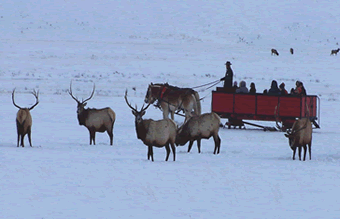
The National Elk Refuge borders the town of Jackson here in Jackson Hole.  .  Last year we had approximately 7500 head of elk wintering on the Refuge.  We take visitors for an hour long ride out on the Refuge among the elk in sleighs  drawn by a team of draft horses.  It is awe inspiring to be out with the large numbers of elk that are there with the beautiful Tetons and Gros Ventre Mountains as backdrops.  Other animals such as eagles, hawks, swans, coyotes, ducks, geese and sometimes wolves are also on the Refuge. 


Looks like an ancestor helped rescue the ill-fated Donnor Party.  Who is your favorite historical Western figure? 

My favorite historical Western figure is probably the trail driving cowboy.  The boys that brought the herds out of Texas to the railroad. 

 If you could have dinner with three Western legends who would they be? What would you like to ask them?

Chief Washakie – Chief of the Shoshoni – I would like to ask him what it was like before all the settlers showed up.


Broken Hand Fitzpatrick – Mountain Man and Wagon Master – I would like to ask him what it was like to be a mountain man and wagon master.

John Slaughter – 17 year old Trail Boss and cowboy – I would like to ask him about the trail driving days.

I think you did a bit of everything during our trip, even teaching me how to rope a steer. What is your favorite task? What is the least?

My favorite task is getting the new guests off the bus on Monday.  My least favorite task is having to load the guests on the bus on Thursday. 

What three cowboy ethics fit you best?  

I think the three that fit me the best are:  Take pride in your work, Ride for the brand and Remember that some things aren’t for sale.

You’re right, Jeff. Those fit you best. Thanks so much for spending the weekend with us here in Wildflower Junction. And don’t be a stranger, ya hear?

Jennie Marsland ~~McShannon’s Chance

Hello all! I’m thrilled to be a guest here on P&P today.  In particular I’d like to thank filly Donna Alward, my chapter mate in Romance Writers of Atlantic Canada – that’s ‘RWA by the C’ – for inviting me. This a great place for lovers of all things Western, especially romance cowboy style.

My debut novel, McShannon’s Chance, was released last winter by Bluewood Publishing. So how does a Canadian Maritimer end up writing a love story set in post-Civil War Colorado? Most people associate this part of the world with stories of adventure at sea, but what a lot of people don’t realize is that the Appalachians end with the hills that border Nova Scotia’s Annapolis Valley, where my family has its roots. We have our own brand of mountain culture here, built around the same values that make up the code of the West – honesty, hard work, respect for the land. My parents grew up listening to the Carter family and Jimmie Rogers, and as a child I devoured my father’s collection of Zane Grey and Louis L’Amour novels.  My heroes have always been cowboys.

My debut novel, McShannon’s Chance, was released last fall in print and as an e-book by Bluewood Publishing. It’s available from Amazon and Barnes&Noble as well. It tells the story of a mail-order marriage between troubled Civil War vet Trey McShannon and Beth Underhill, an independent, headstrong watercolor artist. Needing to marry to avoid being sent back East, Beth accepts Trey’s honest business proposal and soon finds herself drawn to the quiet young homesteader with a taste for Dickens and Walt Whitman and a way with high-strung horses. The attraction is mutual, but Trey has deep wounds to heal and demons to overcome before he can trust the woman who’s captured his heart with her courage and sass. Here’s an excerpt:

Beth turned to the store window and watched the man she’d agreed to marry walk toward her.

Twenty-seven years old, six feet tall, dark hair and eyes. She’d described herself to him in similar meaningless terms. She supposed he’d find them as inadequate as she did.

His rangy frame could have carried more weight, but he had the muscle of a man who did physical work. His long, quick stride suggested latent energy. The way he wore his faded jeans, collarless homespun shirt and battered cloth cap made her think he rarely dressed any other way. She would have guessed him to be over thirty; there wasn’t much of youth about him.

That impression didn’t change when he stepped into the store. Long, thick dark lashes shadowed his molasses-colored eyes, set deep under heavy brows. His straight, wayward, near-black hair needed a trim. The stubble on his angular jaw didn’t make him any less intimidating.

“Excuse me, Miss, are you Beth Underhill?”

He spoke coolly, almost to the point of curtness, with a bare hint of a drawl. Beth’s stomach jolted when their eyes met. She swallowed and caught hold of the edge of a shelf to stop herself from stepping back. Idiot, say something. When she found her voice, it sounded odd and distant to her ears.

“Yes. You must be Trey McShannon.”

I enjoyed seeing the world through Beth’s eyes because watercolor painting is a hobby of mine. I’m also a horse enthusiast, so Trey’s passion for Thoroughbreds was fun for me to write as well. The other major interest in my life is folk music, so the hero of the prequel to Chance, McShannon’s Heart, is a musician. Heart is in edits and will be coming out from Bluewood late this fall or early in the winter.

It’s been wonderful chatting with you today. Don’t forget to comment to be entered in the drawing for an e-copy of McShannon’s Chance. You can also catch up with me on my blog, A Chat with Jennie Marsland, and on my website, http://www.jenniemarsland.webs.com . I’d love to hear from you!

MJ Fredrick ~ Time Travel and Romance

If I could have any superpower, I’d want the power of time travel. I wouldn’t care about going into the future—I’d prefer not to know. But I would LOVE to go into the past. I drive by buildings and wonder what they were like in their heyday. I live in an old city, so there are a lot of old buildings. Depending on my mood, there are different eras I want to visit.

The early 1960s, the era when my mom was young. It’s also the era of Mad Men, and it’s just fascinating to see how different mores were in those days. A lot of the buildings around my neighborhood were built in that era, with the flat roofs and the plate glass, and I would love to see them when they were new.

The 1950s, when my mom was a child. She talks about shopping downtown, and the buildings are still there. I can just imagine her traipsing down the street in her little dress, going to the soda fountain. My dad’s hometown was also thriving in the 1950s, and I would love to experience that small town in that time period. I’d also love to travel Route 66, and stay in those motels along the way.

The post-Civil War era, during western expansion, the time of Laura Ingalls. I devoured those books when I was young, and while I didn’t really care about visiting that time period at the time, now I wonder what it must be like to have experienced that wide-open feeling.

MAYBE I’d want to visit a trail drive. Just for a few hours.

And downtown San Antonio as it recovered after the battle of the Alamo. I’m not sure I’d like to visit the time period that my book, SUNRISE OVER TEXAS from Carina Press, is set, during the time Stephen Austin brought the first families to Texas, when it was still a part of Mexico. The Texas frontier was wild at the time, and the Mexican government wanted it settled. I don’t think I could ever do the things my heroine Kit has to endure.

Time travel would be a fun power to have, but I’d want to return to my own time period, of air conditioning and transportation and hamburgers.

Where would you want to time travel?

MJ will give away a $10 gift card to either Amazon or Barnes & Noble today to one lucky commenter. So get typing!

Linda Ford ~ The History of APRONS


 I remember when women wore aprons over their dresses as they did their daily work. Nowadays, I don’t think our kids even know what an apron is.

The following essay was on this site but also on a number of other sites: http://theopenpantry.blogspot.com/2009/01/history-of-aprons.html

“The principal use of Grandma’s apron was to protect the dress underneath, because she only had a few, it was easier to wash aprons than dresses and they used less material, but along with that, it served as a potholder for  removing hot pans from the oven. It was wonderful for drying children’s tears, and on occasion was even used for cleaning out dirty ears. From the chicken coop, the apron was used for carrying eggs, fussy chicks, and sometimes half-hatched eggs to be finished in the warming oven. (A warming oven was a narrow cabinet above a wood-burning stove, next to the stovepipe.)

“When company came, those aprons were ideal hiding places for shy kids. And when the weather was cold grandma wrapped it around her arms.

“Those big old aprons wiped many a perspiring brow, bent over the hot wood stove. Chips and kindling wood were brought into the kitchen in that apron.

“From the garden, it carried all sorts of vegetables. After the peas had been shelled, it carried out the hulls. In the fall, the apron was used to bring in apples that had fallen from the trees.

“When unexpected company drove up the road, it was surprising how much furniture that old apron could dust in a matter of seconds.

“When dinner was ready, Grandma walked out onto the porch, waved her apron, and the menfolk knew it was time to come in from the fields to dinner.

“It will be a long time before someone invents something that will replace that old-time apron that served so many purposes. “

Aprons have been used for hundreds of year by men and women for a variety of tasks. Perhaps the first mention of the use of an apron is in the Bible when Adam and Eve sewed together fig leaves to make aprons to cover themselves. We traditionally think of aprons being used for cooking, and while that is true, they have served as a cover-up for other tasks that tend to be messy. Occupations such as butchers, welders and bakers have always used aprons to protect both their clothing and bodies from their work.  In fact, men probably wore aprons before women did.

Some interesting facts about aprons.

The word comes from a French word for napkin or small tablecloth.

During earlier times, like maybe the 16th and 17th centuries, colors indicated the trade of the wearer. For instance, English barbers wore a checked pattern, butchers and porters wore green.

A pinafore apron was “pinned” to clothing.

Cooks turned their aprons to hide the stains but only once or the stains weren’t hidden.

I remember the first thing I learned to sew was a half apron that tied around my waist. I also remember when servers at wedding receptions all wore matching aprons. Often the color and style had been chosen by the bride or bride’s mother. I also remember accidently going to school in grade one without removing the apron I wore. I was so embarrassed. Looking back I can’t imagine why it bothered me so but it did.

Here is a site with free patterns for making aprons. http://tipnut.com/56-free-apron-patterns-you-can-make/

We’ve almost forgotten about aprons although my grandson designed an apron for me that I’m very proud of. (That’s it on the right.) In writing historical fiction, I need to remember how they were always worn and how they were used. In my August release, Dakota Cowboy, I used aprons a couple of times but not in my Christmas novella, Christmas Under Western Skies, due out later this year.

Website www.lindaford.org Blog www.lindaford.org/blog

I’ll give away a copy of Dakota Cowboy to one person who comments.

Brenda Minton ~ True Cowboys

Wow, I’m guest blogging at Petticoats and Pistols! When Tracy first mentioned it I actually had to ask her what to talk about! I’ve never guest blogged before. My own blog has been neglected this summer, but previous posts were about exciting things like noises in the night and runaway mules. If I’m going to guest blog, I’m sure I need something a little better than that, something a little more exciting.

Ummm, yeah, I got nothing. My life is about runaway mules, crazy kids, and chasing the Chihuahua down the road. In my spare time, I write for Steeple Hill Love Inspired. Most importantly, I write about cowboys. When I was searching for my niche, cowboys just made sense to me. It wasn’t about what was hot (not that cowboys aren’t) or what the publisher was looking for (although it’s always good to know). No, I picked cowboys because to me, they define HERO.

As an avid fan of the PBR (pro bull riding, for those who might be thinking Pabst Blue Ribbon) I love the sport because it is exciting, dramatic, and dangerous. But I also love it because cowboys are heroes. These men are competing against one another, and yet they are always there to help each other. They cheer for each other. They defend one another. They’re willing to jump into the arena with an angry, one ton bull if it means saving a friend’s life. And they pray for each other..

When I think of cowboys, I think of Cord McCoy, the professional bull rider who also competed on Amazing Race. Cord is a true cowboy. He’s a man of faith who smiles, even when the bulls are against him. Even when he’s losing, he’s smiling. He’s cheering for the guy who is beating him. He’s praying for them to do a great job and stay safe.

But these cowboys are also tough as nails. They can get stomped on by a two thousand pound bull, get back up and say ‘yes’ to a reride. They’ll ride with broken ribs, punctured lungs and torn ACLs.

Tough is the bull rider who jumps in the arena with bull fighters to grab hold of the rope that his unconscious buddy is tangled up in.

When we think of cowboys we think tough, gentle, heroic and chivalrous. A cowboy hero is the whole package–a man sent to rescue his woman. A man in faded jeans, five o’clock shadow and rip hard muscles sent to rescue his woman, and get rescued by her in the process.

John Wayne, Clint Eastwood, George Strait. What could be better than a hero in the mold of one of those men?

So, you ask, why do I write cowboy stories? Well, it should be obvious—the research is a wonderful way to pass a weekend. What better job than a job that takes a girl to the rodeo to watch men in wranglers!

In my August release, THE COWBOY’S SWEETHEART, the reader gets the combination of a tough-as-nails cowboy and the cowgirl who is having his baby. I’m so excited about this book that I’m giving away a copy to one of you who leaves a comment today. I hope you enjoy the story.