

 Hey everyone! Thanks so much for having me over today! As I write stories, I love being able to weave historical events and figures into my fiction. In my first novella, Sioux Summer, published in The Oregon Trail Romance Collection, I was able to do just that. The Grattan Massacre was the conflict that spawned the First Sioux War, and it plays a part in my story.
In August, 1854, near Fort Laramie, Nebraska Territory (present day Wyoming), one lonely cow wandered away from a group of Mormon emigrants traveling the Oregon Trail. The bovine ambled into an encampment of Lakota Sioux containing roughly 4800 men, women, and children and was killed by a visiting Miniconjou warrior named High Forehead.

The cow’s owner who had tracked it down, became fearful at the sight of the Indian encampment, so he went to Fort Laramie and explained the situation to Lt. Hugh Fleming. Fleming approached the Sioux chief, Conquering Bear, to negotiate a solution. The chief offered a horse from his own herd or a cow from the tribe’s herd, but the Mormon man demanded $25 cash. When terms couldn’t be reached, Fleming demanded the arrest of High Forehead. Conquering Bear wouldn’t agree since he had no authority over the Miniconjou tribe, so their negotiations ended in stalemate.
Second Lieutenant John Grattan, a new West Point graduate, took matters into his own hands. With little respect for the Sioux, he, an armed detachment of thirty soldiers, and an interpreter (look into interpret io to know more about their services)went searching for a fight. They marched into the Sioux encampment, intent on arresting High Forehead. The interpreter, who was drunk at the time, taunted the Sioux warriors, promising that the soldiers would kill them. Grattan demanded High Forehead’s surrender. When he refused, Grattan approached Conquering Bear. The chief once more offered a horse in exchange for the dead cow, but Grattan would accept only the arrest of High Forehead. Again, the negotiations ended in stalemate.

What Grattan didn’t know was that the Sioux warriors had flanked the detachment during the negotiations. As he returned to his horse, one soldier became so nervous he fired a shot, and the bullet struck and killed the Sioux chief. With bows and arrows, the Sioux killed Grattan and eleven others. The remaining men retreated to a rocky outcropping nearby, but the warriors, led by rising war chief Red Cloud, pursued and killed them all.
For days, the Sioux raided nearby settlers, trading posts, and Fort Laramie. Finally, the Indians abandoned the area for their respective hunting grounds, and in so doing, broke the 1851 Treaty of Fort Laramie. When a burial party went into the encampment, the thirty soldiers’ bodies were found mutilated almost beyond recognition.

News of the Grattan Massacre reached the War Department, and a plan for retaliation was formed. On September 3, 1855, a 700-soldier force led by Colonel William Harney descended on an encampment of 250 Brulé Sioux along Ash Creek. The soldiers killed more than one hundred Sioux men, women, and children and took roughly seventy prisoners. So began a long history of attacks and retaliations that continued for many years. And…the Battle of Ash Creek is directly linked to one of the most famous cases of retaliation in all of Indian war history. One of the young boys who witnessed the massacre at Ash Creek grew into the great Sioux warrior, Crazy Horse, who fought and killed Custer twenty-one years later at the Little Big Horn.
I hope you’ll be interested to see how The Grattan Massacre fits into my story, Sioux Summer.
You can find The Oregon Trail Romance Collection at bookstores everywhere, or purchase from Amazon. And to one lucky reader, I’ll be giving away an autographed copy. Leave a comment below to enter the drawing.


 My wagon is loaded full of thanks to the Fillies for inviting me over to Petticoats and Pistols today.
 Evening gowns of the day often featured frilly embellishments with lace and ruffles. Ornaments of beading, spangles, rhinestones, and velvet ribbon were popular, as were skirts that flared at the hem, most with short trains.
 The wheat on this dress makes me think of the women from my Pendleton Petticoats series. Pendleton, Oregon, the setting for the stories, was (and is) wheat country. It’s easy to picture one of the characters wearing this gown.
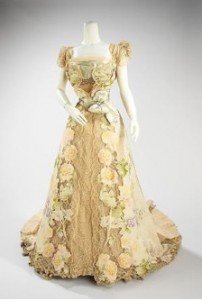 I lose the ability to think rationally when I see the combination of roses and lace. This gown whispers quite loudly to my heart and makes me wish I could attend a ball.


 he second book in the
 Lacy
 Aundy (Book 1) – One stubborn mail-order bride finds the courage to carry on when she’s widowed before ever truly becoming a wife, but opening her heart to love again may be more than she can bear.
 Convinced everyone deserves a happy ending, hopeless romantic Shanna Hatfield is out to make it happen one story at a time. Her best-selling sweet historical and contemporary romances combine humor and heart-pumping moments with realistic characters. In addition to blogging and eating too much chocolate, she is completely smitten with her husband, lovingly known as Captain Cavedweller.


 d’ from their farm, and even though my birth was in 1940, they still lived much as our ancestors had.


